

Windletter #135 - Nabrawind validates Skylift: a crane-less installation system in extreme wind conditions
Also: Principle Power’s WindFloat reaches 105 MW of operational capacity, work progresses on the world’s tallest wind turbine tower, Tâmega comes online with 38 Vestas V172-7.2 MW turbines, and more.


Hello everyone and welcome to a new issue of Windletter. I'm Sergio Fernández Munguía (@Sergio_FerMun) and here we discuss the latest news in the wind power sector from a different perspective. If you're not subscribed to the newsletter, you can do so here.
Windletter is sponsored by:
🔹 Tetrace. Reference provider of O&M services, engineering, supervision, and spare parts in the renewable energy market. More information here.
🔹 RenerCycle. Development and commercialization of specialized circular economy solutions and services for renewable energies. More information here.
🔹 Nabrawind. Design, development, manufacturing, and commercialization of advanced wind technologies. More information here.
🔹 Ingeteam Wind Energy. A global technology and services partner for the wind energy industry, working with OEMs, utilities and asset owners. Find out more here.
Windletter está disponible en español aquí
The most-read items from the last edition were: the hybrid tower to be installed by Goldwind in Brazil, wind turbine wakes seen from space, and the results of the German auction.
Also, last week we published a Windstory about WHEEL, an interesting floating prototype.

Now, let’s get into this week’s news.
Windletter is a publication supported by its community of readers. If you enjoy the content and want to be part of this community, you can subscribe for free or join as a paid subscriber to support the publication.
🏗️ Nabrawind validates Skylift: a crane-less installation system in extreme wind conditions
Nabrawind has completed the installation of the first Goldwind GW165/6000 turbine at the Diaz wind farm (Namibia) using its Skylift system, doing away with the heavy-tonnage cranes normally required for this operation.
The milestone has two readings. First, the commercial validation of Skylift in a real commercial project with a 6 MW direct-drive machine. Second, and probably the most relevant for the market, is that the operation was completed with average wind speeds of up to 15 m/s and gusts of up to 20 m/s, conditions in which conventional cranes cannot operate (their usual limit is between 6 and 8 m/s for blade lifts).
At a site like Diaz, located in one of the windiest regions in the world, this capability is especially relevant to keep the project on schedule and on plan.
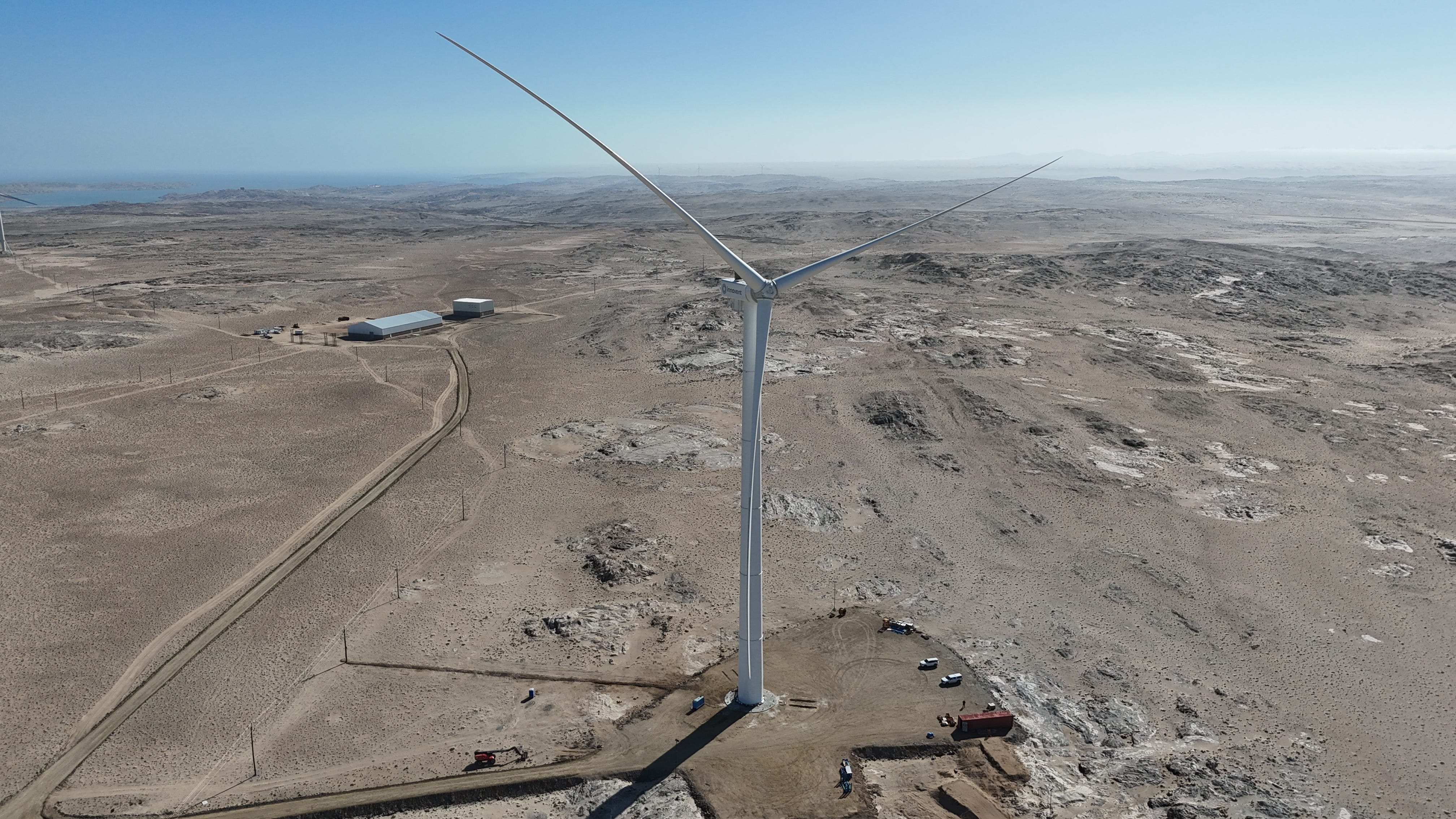
The Diaz wind farm: context
We have already covered the Díaz wind farm in Windletter: in edition #97, dedicated to the arrival of wind power in Namibia, and in #114, where Nabrawind announced its first multi-turbine project.
Diaz is located south of Lüderitz, on the Atlantic coast of Namibia, and is developed by InnoVent, a French developer with a clear commitment to innovative technologies and a consolidated presence in Africa. When fully operational, it will generate 230 GWh per year, equivalent to 6% of the country’s electricity demand. That is a very meaningful figure, given that Namibia currently imports between 60% and 70% of its electricity from South Africa.
The wind farm combines two types of technology at the same site:
4 XMEC-Darwind XE93-2000 turbines (2 MW), already installed on Nabrabase foundations as part of the first phase.
7 Goldwind GW165/6000 turbines (6 MW), of which the first unit has just been installed with Skylift.
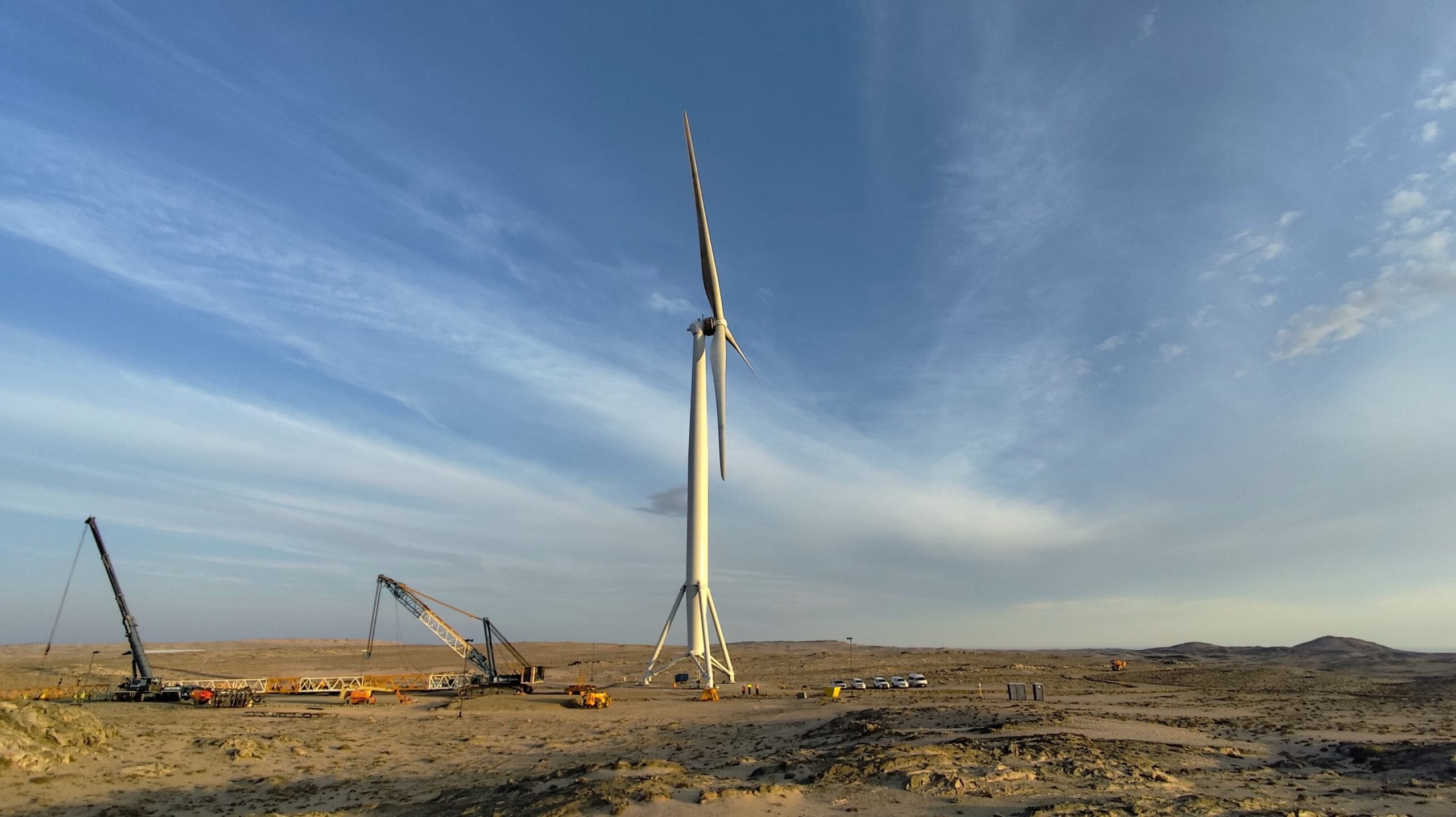
What Skylift is and where it comes from
To understand what Nabrawind is doing at Diaz, you need to go back a few years. The company started in 2017 with Nabralift, a self-erecting tower with a “tripod” design at the base, which led to the tallest wind turbine in Africa, in Morocco. The big innovation was not just the tower, but the self-erecting system that raised it: the SES (Self-Erecting System), which avoided heavy cranes to reach great heights.
The next step was BladeRunner, a patented system to install blades individually from the hub, also without the need for a heavy crane.
With both technologies in hand, the logical next move was to combine them. And that is Skylift: the self-erecting system (Total SES), adapted to conventional tubular towers and integrated with BladeRunner. The result is a system capable of lifting tower, nacelle, rotor and blades without heavy-tonnage cranes. Skylift was first introduced in March 2023, but it hadn’t been deployed in a commercial project until Diaz.
The conceptual advantage over a classic crawler crane is twofold: on the one hand, the logistical dependency of moving a heavy-tonnage crane to the site is eliminated (something that in places like Namibia, with limited access roads, can be unfeasible or extremely expensive). On the other, the operation is decoupled from the wind window, expanding the operating range from 6-8 m/s to 15 m/s.
The technical challenge of installing a direct-drive turbine with Skylift
Diaz is the first time Skylift has been used with a wind turbine under real conditions. And to start with, it has had to prove itself with a direct-drive turbine, one of the most demanding scenarios for the system.
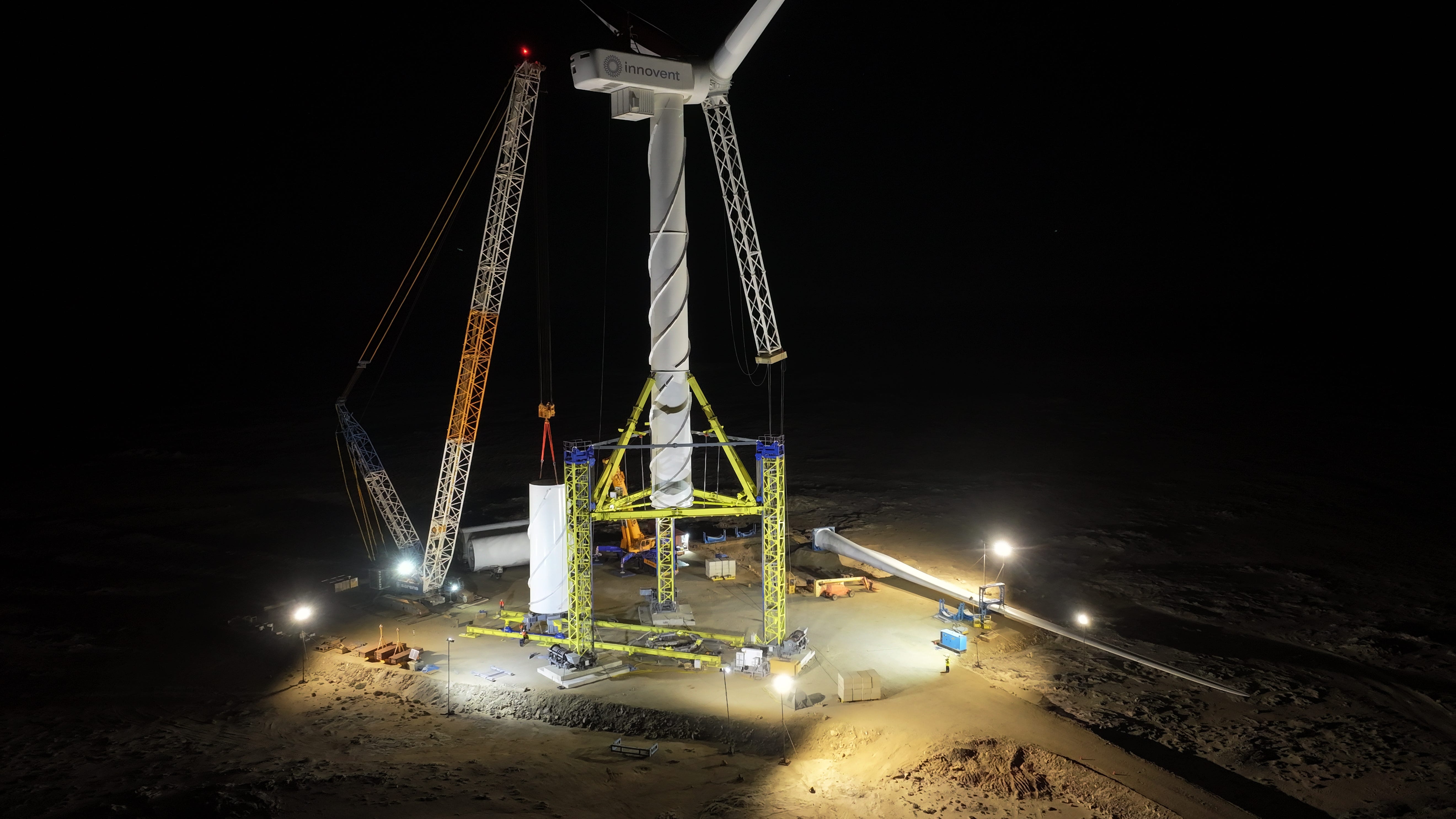
The sequence deployed at Diaz, as described by Nabrawind, is the following:
Installation of the first tubular tower section and the nacelle using the Total SES system, which uses the tower structure itself as a guide and avoids the usual heavy-tonnage crane.
Installation of two of the three blades at 30° from the ground, using Nabrawind’s proprietary handling system. This is the first time this solution has been used with two blades in a 30° position, which represents a maximum degree of difficulty for the project. In a conventional installation, the blades would be mounted directly at final hub height (90-120 metres), with all that this implies in terms of cranes, wind windows and schedules.
Placement of a counterweight in the slot reserved for the third blade, responsible for dynamically stabilising the rotor during the lift.
Lifting of the tower-nacelle-rotor-two-blades-counterweight assembly to final hub height, by means of the self-erecting system and the incorporation of the remaining tower sections.
Replacement of the counterweight by the third blade at height, using the BladeRunner system that lifts and connects the blade directly from the ground.
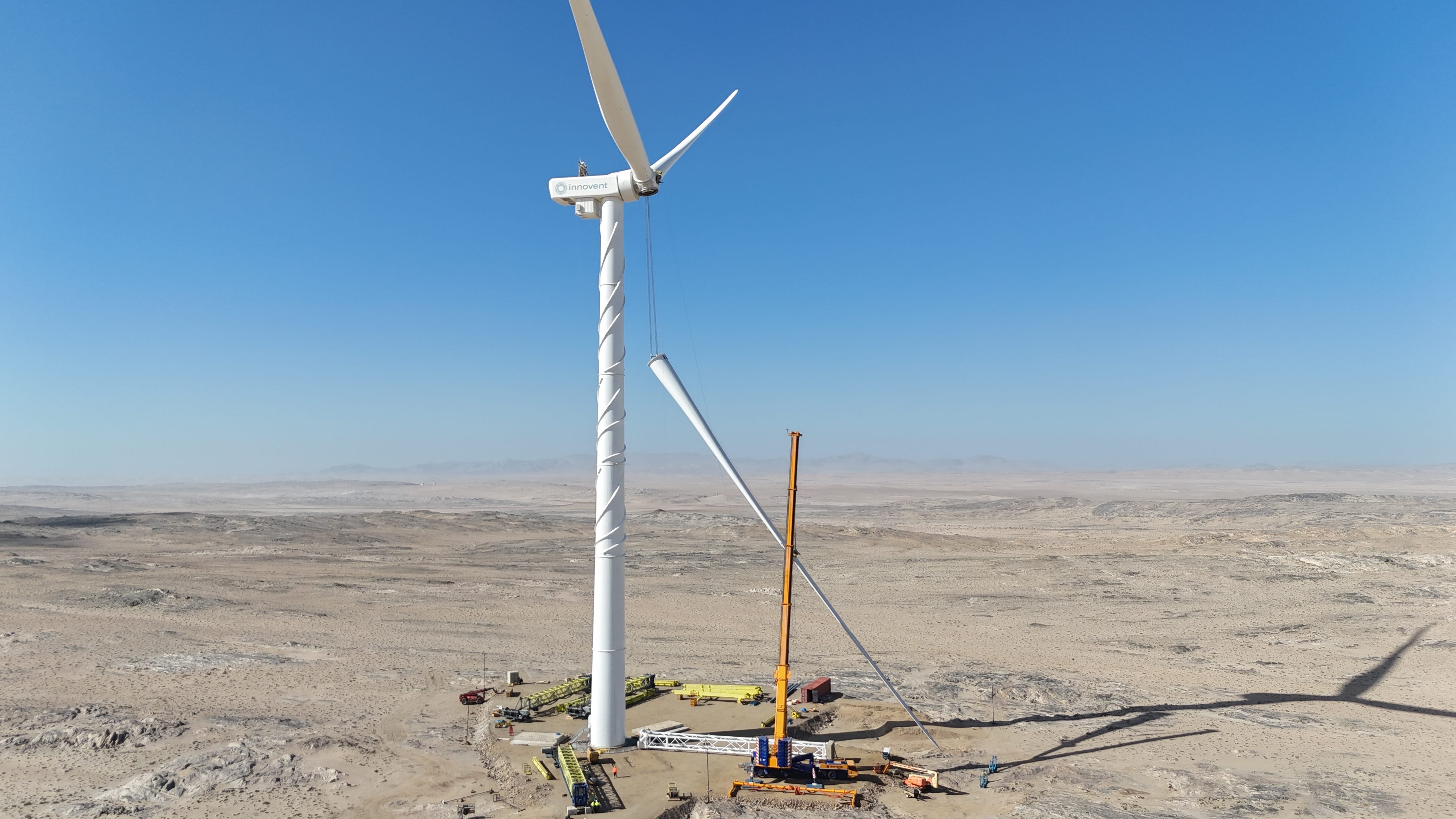
The target pace: 1 turbine per week
For now, this is the first turbine installed at Diaz. Six more remain. And it is precisely on those six that Nabrawind has to prove that it is possible to operate Skylift in series conditions. The company’s stated objective is to reach a net installation cycle of one week on the seventh turbine.
To put that pace in context: a conventional installation with a crawler crane, under favourable conditions, can take between 5 and 10 days per onshore turbine. But at sites with high average wind speeds like Diaz, frequent wind-related stoppages are common. Skylift makes it much more likely to keep the project on schedule.
If the system confirms that pace on the next six units, Nabrawind will have a very strong commercial case to sell Skylift in similar locations: onshore wind farms in remote areas with high mean winds and logistical difficulties. And, why not, also at sites where the main crane is a bottleneck.
By the way, let’s remember that Nabrawind was acquired in 2025 by Australian group Fortescue, reinforcing its positioning in industrial decarbonisation projects under the “Real Zero” umbrella.
Disclaimer: Nabrawind is one of Windletter’s current sponsors, but this is not sponsored content. The decision to cover it and the editorial angle are entirely mine.

🌊 France merges the AO9 and AO10 auctions and will award 10 GW offshore
The French Government has announced that it is combining the AO9 and AO10 auctions into a single award process that will bring around 10 GW of offshore wind to market. Contracts are expected to be awarded in late 2026 or early 2027.
As we previewed in edition #107, AO10 was originally planned to award between 8.4 and 9.2 GW, and AO9 (whose 12 prequalified participants we already knew about back in November 2024) was set to distribute around 1.5 GW between fixed-bottom and floating. Combining both into a single process is a decision that gives greater visibility and scale to the French pipeline.
The new format brings around 10 GW of capacity to market, split 50/50 between fixed-bottom and floating, distributed across 10 lots with individual sizes between 550 MW and 1.35 GW. The French Government has set a target price below €100/MWh on average.
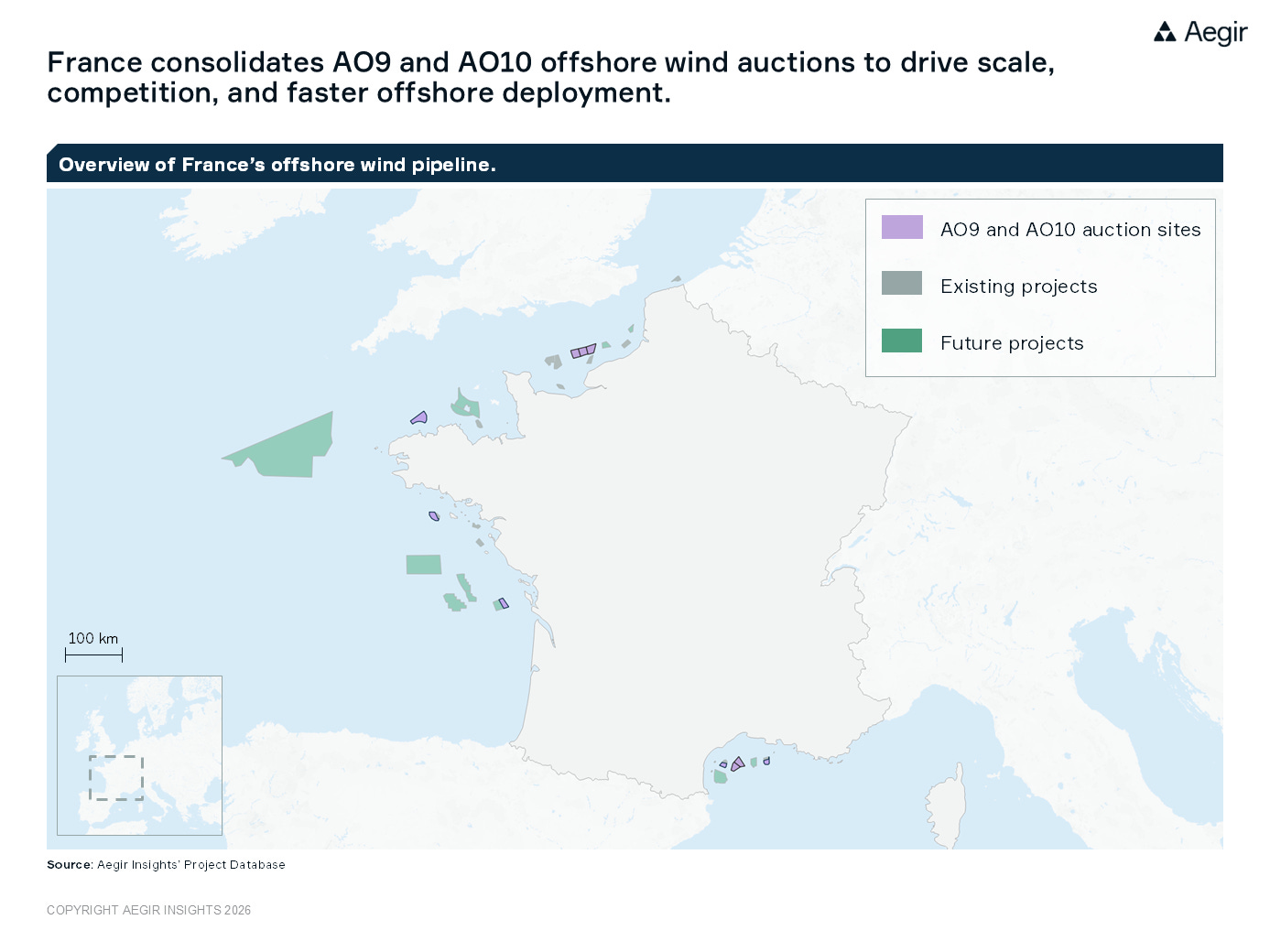
One relevant novelty: for the first time in a French auction, the award criteria will include industrial resilience, environmental performance and cybersecurity, applied alongside price. The Government explicitly cites the intent to limit the use of certain non-European components, with particular attention to turbines and permanent magnets. In other words, a practical application of the European Net Zero Industry Act in the largest auction of the year in Europe.

⚓ Principle Power’s WindFloat design celebrates 105 MW of operating floating wind
The EFGL pilot floating wind farm (Les Éoliennes Flottantes du Golfe du Lion), located 16 km off the coast of Leucate and Le Barcarès, in the French Mediterranean, has produced its first megawatt-hours.
And with this milestone, Principle Power celebrates a new record for its WindFloat technology: 105 MW operating in the world.

What is interesting about this track record is that Principle Power is one of only two floating platform technologists that has crossed 100 MW operating worldwide. The other is Equinor, with its three Hywind projects (Demo, Scotland and Tampen) based on spar technology, adding up to around 118 MW (depending on how installed capacity is counted).
The rest of the market is far behind:
BW Ideol has just 5 MW operating with its Damping Pool, soon to be joined, if not already, by the 30 MW from Eolmed.
Stiesdal has a single TetraSpar demonstrator of 3.6 MW.
SBM Offshore has recently connected its 25 MW Provence Grand Large with a TLP platform.
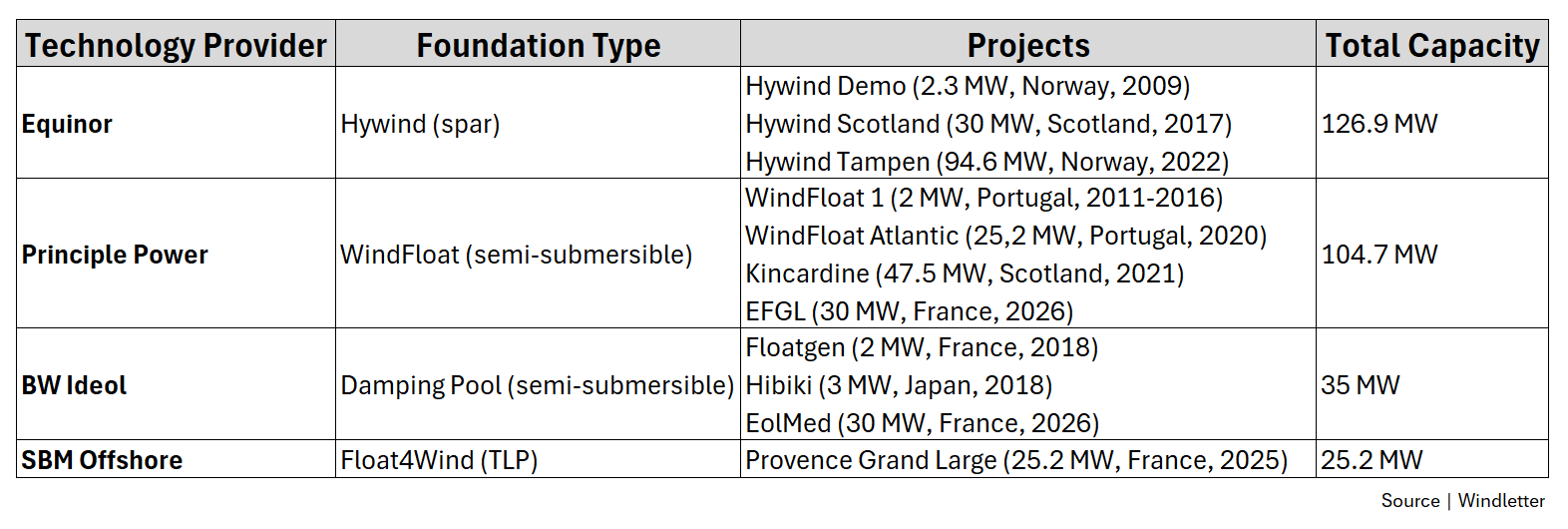
The three V164-10 MW units at EFGL are, as of today, the largest turbines ever installed on a floating foundation (excluding China). EFGL is also the second floating wind farm in the French Mediterranean after Provence Grand Large, and will serve as a reference for the 250 MW commercial project (EFLO) awarded to Ocean Winds and Banque des Territoires in the French auction, as we discussed in edition #113.
Is this track record enough to make the leap to large-scale commercial wind farms? Looking at the data, it would seem that the Principle Power-Vestas and Equinor-Siemens Gamesa ecosystems are the most solid bet right now, at least in terms of experience.

⚡ Offshore wind farm overplanting in Germany: what is the optimal level?
In offshore wind farms, the grid connection has a huge cost: subsea cables hundreds of kilometres long, HVDC converters, substations... and it doesn’t always make sense to size it for the maximum capacity of the wind farm.
Let’s take a numerical example: for a given evacuation capacity (say, 1 GW), what is the optimal installed turbine capacity? 1 GW? 1.1 GW? 1.2 GW?
This question is key in the case of Germany, since all the offshore evacuation infrastructure, offshore substation, high-voltage subsea cable and onshore section up to the grid connection point, is borne by the grid operator, not by the wind farm developer.
The idea of overplanting (overplanting or Überbauung in German) consists of installing more wind capacity than the connection cable can evacuate. During high-wind hours, part of the generation is lost. In exchange, the infrastructure is used much more efficiently the rest of the time. You could say it has a higher use factor or capacity factor (if that term can be used for infrastructure).
The German marine regulator BSH proposed in its 2025 Area Development Plan a mandatory 20% overplanting for the new offshore zones in the North Sea. That is, wind farms would have to install 20% more capacity than their grid connection can evacuate. But this hasn’t been entirely well received by developers.
Now a new study by Frontier Economics, commissioned by the German offshore wind association BWO and the energy industry body BDEW, concludes that the economic optimum lies between 5 and 10%, not 20%.
According to the study, the economic optimum for the developer and for the power system do not match: it would be 2.5-5% for the former, while it would be around 5-10% for the latter.
The most interesting conclusion of the study is not the number itself, but the design of the system: when the cost of the evacuation infrastructure is not borne by the developer, incentives misalign. Setting a mandatory percentage doesn’t seem to be the best solution either.

🗼 Work progresses on GICON, the tallest wind tower in the world
GICON has completed the installation of the second structural segment of its high-altitude wind tower in Schipkau (Germany). The works are progressing on schedule and the project is one step closer to becoming the tallest wind tower in the world.
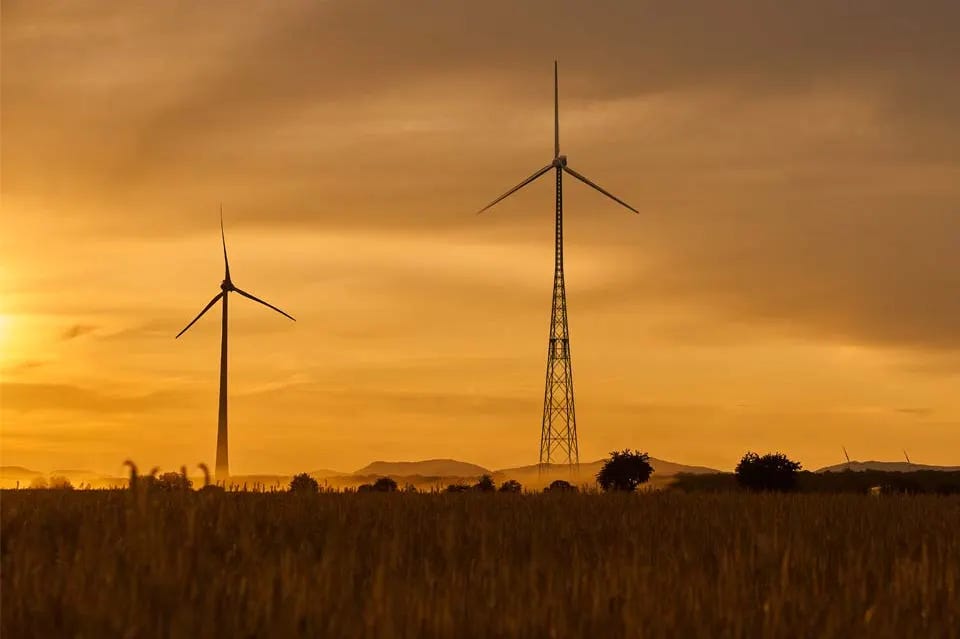
Let’s remember that in edition #123 we covered this project in detail. The key data:
Hub height: 300 m
Total height (tip height): 365 m
Structure: four-pillar lattice (not tubular)
Turbine: Vensys 126-3.8 MW
Steel weight: >2,000 tonnes
Individual parts: ~22,000
It will be the second tallest structure in Germany, only behind the Berlin TV tower by just three metres.
Back to the current milestone: with the installation of the UTS-02 module, the tower has now reached 85.7 metres in height. The piece weighs 350 tonnes, measures 40x40x40 metres, and was lifted with a Liebherr LR 11350 crawler crane (maximum capacity of 1,350 t and hook height of up to 220 m).
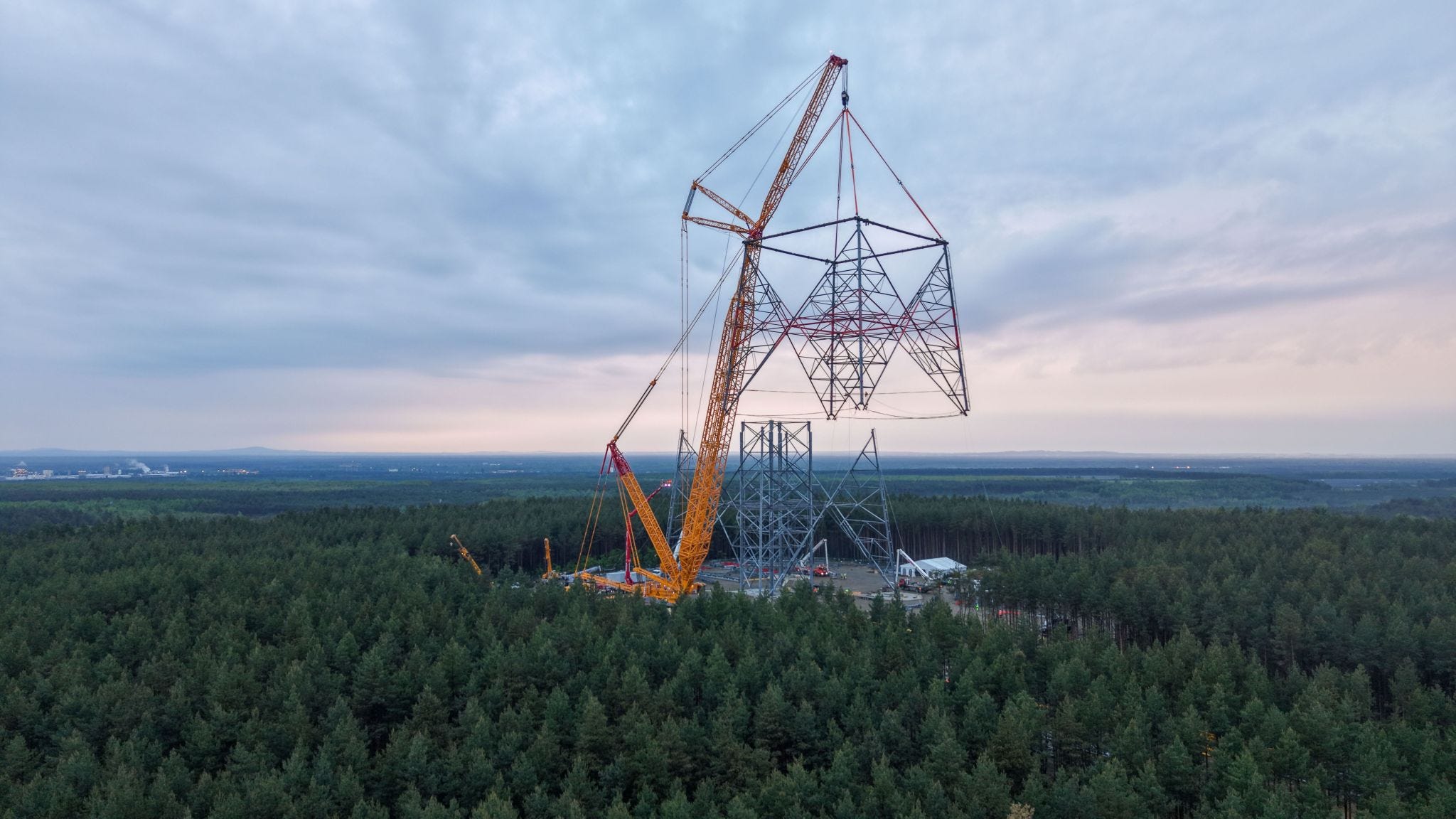
According to the crane operating company, Schmidbauer: “it is probably one of the largest single lifts ever carried out with an LR 11350 in terms of dimensions”, although the weight was moderate compared to typical lifts in the petrochemical or offshore sector.
Professor Jochen Großmann, CEO and founder of GICON, has pointed out that the remaining steel segments could all be assembled within the next two months, although he insists that “safety comes before speed”. If construction continues at this pace, the silhouette of the tower should be complete this summer, pending the telescopic assembly of the Vensys nacelle and its final lift to 300 metres.
For more information, read edition #123.

🇵🇹 The Tâmega wind farm, with 38 Vestas V172-7.2 MW units, comes online
Iberdrola and Vestas have connected the Tâmega Norte wind farm to the grid, which is the largest wind farm in Portugal and, probably, in the entire Iberian Peninsula. The first phase, of 195 MW, started generating on 30 April.
Total capacity: 274 MW (Tâmega Norte + Tâmega Sur)
Turbines: 38 x Vestas V172-7.2 MW
Estimated output: ~600 GWh/year
Investment: ~€350 M
Location: north of Portugal, on the Tâmega river (a tributary of the Douro)
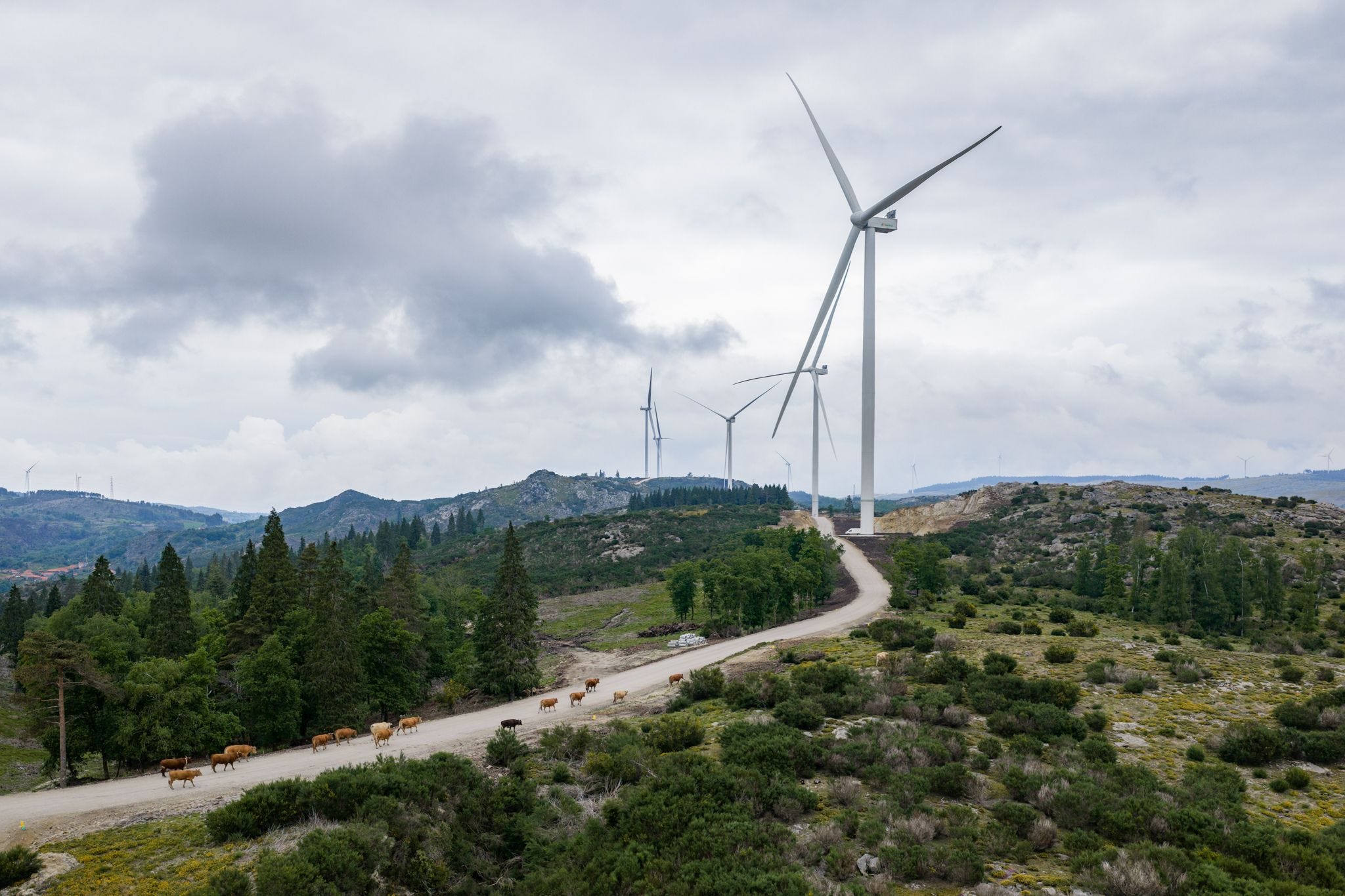
What is unique about Tâmega is that it is not just a wind farm. It is a complement to what Iberdrola itself has called the Tâmega Gigabattery, a 1,158 MW pumped hydro plant capable of storing 40 GWh.
On the manufacturer’s side, Tâmega is the largest wind farm equipped with the V172-7.2 MW to date. As you already know, this is the largest model in Vestas’s onshore portfolio, based on the EnVentus platform and featuring its characteristic modular nacelle design. The first commercial unit was installed in Salzkotten (Germany) in September 2025, as we covered in edition #112. Tâmega is the first time it has been deployed at this scale.
Vestas reports having operated on site with up to five simultaneous cranes and an installation pace of 2.5 turbines per week, with blades arriving from Poland and nacelles from Denmark.
The wind farm is located in an area with relatively complex orography, so the transport of components has been a challenge. When we talk about one of the largest models in the market and the use of a blade lifter system, all that’s left is to enjoy.
The images are from Laso, a specialised transport company, and show the transport of blades through the roads of Portugal.
The blade lifter is the system that allows large blades to be transported on conventional roads, tilting them vertically to overcome curves and obstacles that would be impossible with conventional transport.
If you enjoy this type of transport videos, I recommend you check out Windstory #18.

Thank you very much for reading Windletter and many thanks to Tetrace, RenerCycle, Nabrawind and Ingeteam, our main sponsors, for making it possible.
And if you feel like it, recommend Windletter to help me grow 🚀
See you next time!
Disclaimer: The opinions presented in Windletter are mine and do not necessarily reflect the views of my employer.